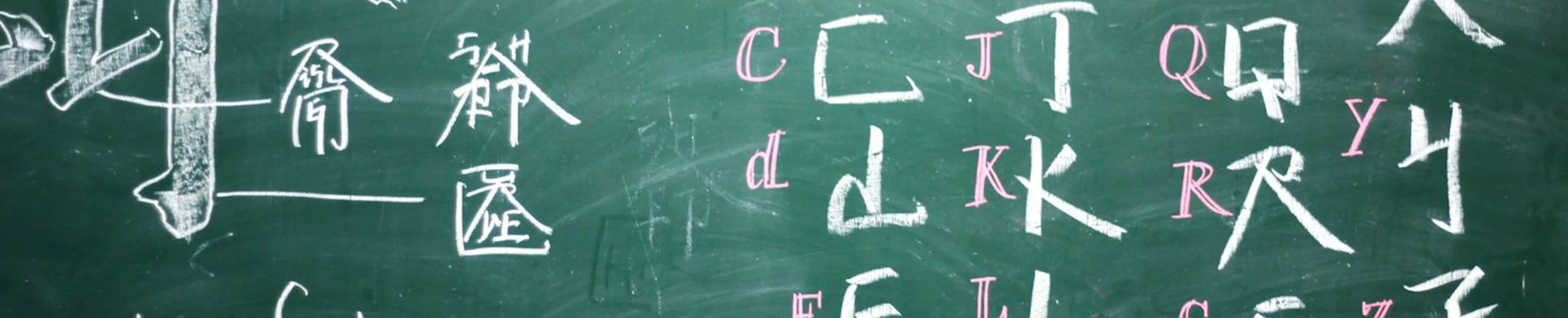
Can't Even Copy Correctly? The Changing State of Handwriting in Hong Kong Primary Schools

 Cover photo image credit: Unsplash
“Even when you give kids the answers to copy, they still can’t get full marks”. I invited my university classmate and good friend, Ms. Lam, a Chinese-language teacher with ten years of experience in Hong Kong primary schools, to help unpack two tasks that sound basic but are often overlooked in Chinese language learning: copying and dictation.
From psycholinguistics, to the government’s curriculum guidelines, to the way we grip a pencil, to what handwriting even means in the age of AI, we take a deep dive into how handwriting ability is changing among young learners in Hong Kong, and the challenges that come with it.
This podcast episode is now live: “Can’t Even Copy Correctly? (Audio in Cantonese)”:
The Joke That’s Actually a Warning Sign
There’s a joke Hong Kong primary school teachers keep making to each other: “Even when you give kids the answers to copy, they still can’t get full marks”.
It sounds absurd. If a child is looking straight at the correct answer, how do they still get it wrong? But teachers across grade levels see this constantly, and it points to something deeper about how children actually learn to read and write Chinese.
The full, word for word transcript (translated in English from the original Cantonese audio) of my conversation with Ms. Lam is available on my Substack. Here’s a plain-language summary of what we covered.
Ms. Lam explained that the joke isn’t really about laziness. It’s become a kind of shorthand among teachers because they’ve noticed a real pattern: students being careless in ways that are hard to explain. Even with a model answer directly in front of them, children copying it make frequent mistakes and lose marks. This happens at both junior and senior primary levels, which is part of why the joke has stuck around.
It’s not just a classroom problem either. Parents run into the same thing at home. A child doesn’t know how to write a character, asks an adult, watches the adult write it out on scratch paper, then copies it, and still gets it wrong. It’s a small moment, but it captures something real about how much is actually happening when a child copies a character, and how easy it is to assume that copying is the easy part.
Copying and Dictation Are Not the Same Skill
Before going further, it helps to differentiate a few concepts that sound similar but are cognitively quite different.
Character recognition is simply the ability to look at a character and read it aloud. Interestingly, research on Hong Kong children shows that before around Grade 4 or 5, kids who haven’t been explicitly taught to break characters into components tend to memorise each character as one whole visual image (Tong & McBride-Chang, 2010), the same way you’d recognise a friend’s face without being able to describe the exact shape of their nose. This is called holistic processing.
Copying and dictation, though, are different tasks entirely, even though both involve producing a character by hand.
With copying, a model character sits right in front of the child. They can look at it while writing and check their own work afterward. It leans on visual tracking and short-term memory, holding the character’s shape in mind just long enough to put it on paper.
Dictation removes the model entirely. There’s nothing to look at. The child has to pull the character’s shape from long-term memory while simultaneously processing the sound they just heard, which places much heavier demands on memory overall.
This distinction turns out to matter a lot. A 2011 study by McBride-Chang and colleagues, looking at Hong Kong students in Primary 3 and 4, found that even after controlling for intelligence and general orthographic processing ability, a child’s copying skill independently predicted how well they could recognise characters and perform on dictation. In other words, copying isn’t just a warm-up version of dictation. It’s a distinct skill that contributes something of its own to a child’s overall literacy.
What Hong Kong’s Curriculum Actually Asks of Six-Year-Olds?
The Hong Kong Education Bureau’s current guidelines for junior primary Chinese follow a principle of “more character recognition, more vocabulary recognition, moderate dictation.” Recognition and writing are treated as separate goals. The idea is to expand what children can read quickly, without correspondingly expanding how much they’re required to write by hand.
According to Ms. lam, by the end of Primary 3, the general target is for students to recognise somewhere between 1,200 and 1,500 commonly used characters, an estimate schools derive from the Hong Kong Primary School Word List, which is publicly available online.
But recognition is only one piece. Starting in Primary 1, children are also expected to learn basic strokes (horizontal, vertical, left-falling, diagonal) and how to name and write each one, common radicals and components, like the “three dots of water” (氵), the “four dots of fire” (灬), or the “speech” radical (言), including how these change shape depending on where they sit in a character, and the difference between a radical and a shared component. For instance, the character 青 shows up in words paired with the “insect” radical or the “speech” radical to form entirely different meanings, and children need to learn to use these patterns to infer both sound and meaning. They also learn character structure: top-bottom, left-right, semi-enclosed, fully enclosed, patterns that students are expected to be able to name by Primary 1.
Alongside all of this, the curriculum places real emphasis on writing mechanics: pencil grip, stroke order, and whether a child is even using appropriate writing tools. Teachers are expected to coach this directly and to communicate with parents about reinforcing it at home. It’s a lot to ask of a six-year-old in their first year of formal schooling. It’s also worth remembering that mechanical, repetitive copying (writing the same character dozens of times) is actually discouraged by the Education Bureau today. What’s assigned now is meant to be more deliberate, if lighter in volume.
How Hong Kong Kids Actually Perform in Practice?
Ms. Lam’s school gives incoming Primary 1 students a pre-test on 150 common high-frequency characters. The spread is wide: weaker students might recognise only a dozen or so, while stronger students can already recognise over a hundred.
Writing is a separate story. Many children arrive without a proper pencil grip. Some press so hard it hurts, others barely press at all, leaving faint, unclear marks. Stroke order is often wrong, simply because kindergarten involves relatively little actual writing. In more serious cases, some children can’t yet write their own Chinese name correctly and need to be corrected stroke by stroke.
By the end of Primary 1, the gap narrows somewhat. Some students recognise all 150 characters, though weaker students might only reach fifty. Most children have adopted a correct pencil grip by this point, though it needs constant reinforcement, and a “speed over accuracy” pattern is common: write carefully and you slow down dramatically, but with only about thirty-five minutes per lesson, there’s real pressure to be both fast and accurate, a combination not many students manage yet.
Why This Matters Far Beyond Chinese Class?
It would be easy to file all of this under “Chinese class problems,” but Ms. Lam was clear that the effects reach much further.
Grades 1 through 3 are essentially about learning how to read. If a child’s vocabulary is thin at this stage, that shaky foundation shows up everywhere. Math, Humanities, and Science all rely heavily on written Chinese, so weak character recognition drags down performance across subjects. Exams reflect this directly too: writing the wrong character, or getting a unit of measurement wrong in a Math word problem, costs marks in that subject, not just in Chinese.
There’s also a developmental argument. Ms. Lam pointed to research suggesting that handwriting stimulates the brain through muscle-based training, supporting neural network development more broadly. The physical process of writing, figuring out stroke order, balancing a character’s structure, also builds logical thinking and spatial awareness, skills that show up well beyond language class.
Do Kids Even Need Handwriting Anymore?
This is the question Ms. Lam says students themselves ask her constantly: “Ms. Lam, we all use tablets now. Why do we still need to practise handwriting?”
Her answer is that handwriting was never really about producing neat output. A printer already does that better, faster, and without mistakes. The actual value of handwriting is in what it trains: the brain’s neural networks, yes, but also self-monitoring and self-correction. While writing, a child is constantly checking their own work against the model, building focus and attentiveness in the process. Handwriting also builds something closer to patience, the ability to push through ten vocabulary words even when you want to quit by the fifth. None of this is something an AI tool or tablet can replace.
At the same time, she’s clear-eyed about where technology already fits in. Hong Kong schools now generally run BYOD (Bring Your Own Device) programmes, and for group tasks or research, students overwhelmingly reach for voice input over handwriting. It’s simply faster. Interestingly, though, voice input has a real weak spot: if a child’s pronunciation isn’t precise, or the classroom is noisy, the device can’t recognise the character they mean, and the student has to fall back on handwriting or pinyin input instead. Handwriting, in other words, hasn’t become obsolete. It’s become a backup skill that’s still very much required.
Practical Tips for Teachers and Parents
Ms. Lam shared a handful of concrete techniques that came up in the full conversation.
Sky-writing and chanting: having children trace strokes in the air, following a teacher’s hand, before ever putting pencil to paper. It builds stroke order through movement rather than static repetition.
Color-coding connecting strokes: using a coloured pen to mark specific strokes helps children learn to count strokes accurately, which in turn helps them catch their own mistakes. An added or missing stroke can turn one character into a completely different one.
Mnemonics and storytelling: decoding a complex character into its components and building a small story around them. Ms. Lam’s own example, for the character 邊 (meaning “side”), turns the components into a tale about someone going to the beach, meeting a square-shaped monster, and escaping on a boat, a playful way to lock in both the shape and the stroke order.
For parents without much spare time, she suggested simple, low-effort ways to build the underlying skills: character-guessing riddles during the car ride to school, and fine-motor-skill games like pinching clothespins, playing with playdough, or practicing buttons and shoelaces, all of which support the hand control that handwriting depends on.
Her broader point, though, was less about technique and more about presence. Children consistently say what they want most on weekends is simply for a parent to play with them. Learning that happens inside that kind of relaxed, connected time tends to stick far better than anything drilled through repetition alone.
Take-Home Message
Ms. Lam and I closed the conversation with a reminder that’s easy to lose sight of when you’re staring down a stack of dictation tests: a child’s learning is a long process, and mistakes are part of how they get better, not a sign that something’s going wrong. Growth isn’t a straight line. It has its ups and downs, but the overall learning curve, given room to make experience trials-and-error, would move upward.
References:
- McBride-Chang, C., Chung, K. K., & Tong, X. (2011). Copying skills in relation to word reading and writing in Chinese children with and without dyslexia. Journal of Experimental Child Psychology, 110(3), 422-433.
- Tong, X., & McBride-Chang, C. (2010). Developmental models of learning to read Chinese words. Developmental Psychology, 46(6), 1662–1676.
This is a summary of my conversation with Ms. Lam on my podcast, Pacing Between Classroom and Lab. For the complete, word for word transcript translated into English, head over to my Substack post.

I am a researcher in psycholinguistics at the Ludwig-Maximilians-University of Munich, formerly trained and served as a Chinese language teacher in Hong Kong primary and secondary schools. My research revolves around the cognitive mechanisms underlying reading development and the methodology used to identify subtypes of developmental dyslexia. I also build infrastructures based on metascientific principles to help synthesise research findings in psychological sciences. I am committed to bridging the gap between scientific research and the actual practice in the educational and clinical settings. My goal is to translate cross-disciplinary knowledge for researchers, educators, practitioners, and parents by connecting insights across fields. I am currently leading the Re-SearchTerms Project at FORRT.
🌐 This website is bilingual (English / 繁體中文). Use the language switcher in the navigation bar to browse in your preferred language.