
A Sun is but a Morning Star"—Reading Thoreau's "Walden

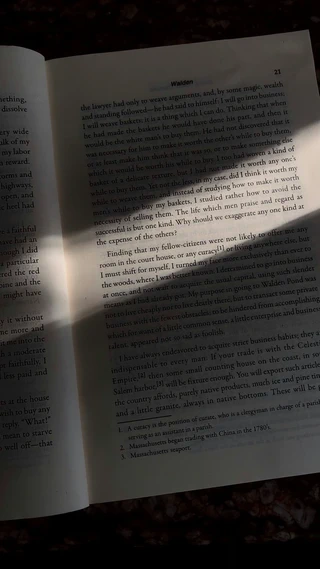 Image credit: Unsplash
I finished Henry Thoreau’s “Walden” or “Life in the Woods” in a psychologically-drunk state. I purchased this book back in June as I needed to learn to enjoy solitude during the Corona times. The book didn’t disappoint me.
I’d say, the latter part of the book was a bit long-winded for me. The philosophical introspection in the first part of the book was pleasurably stimulating though. But the most thought-provoking excerpt was the final words at the very end:
“The light which puts out our eyes is darkness to us. Only that day dawns to which we are awake. There is more day to dawn. The sun is but a morning star.”
I guess a lot of blogs and book reviews have discussed the implied meaning of this excerpt. I was also trying hard to understand what Thoreau really meant. Well, according to my limited knowledge of literature analysis (acquired during my Bachelor’s), the readers, for sure, are allowed to have their own interpretations. Here’s my interpretation:
Under what circumstances can “light” be defined as “darkness”? These are seemingly paradoxical concepts, yet I prefer to see them as relative concepts of the same dimension. When one is used to darkness, a sudden exposure to light, or even the flaming sun, will result in “temporary blindness” due to difficulties in adapting to the change in light intensity. This means that regardless of the presence/absence of light, a sudden change in lightness will lead to darkness, anyway. Here, lightness symbolises awakeness, whereas darkness symbolises ignorance.
Then, how can one be awaken? Only when it’s at dawn, where the sky is illuminating gradually without the hustle and bustle, one can stay sober. Yet, one has to be aware that dawn is always fleeting, compared to the relatively long daytime. Can we catch that particularly short period of time everyday? And who would be willing to do so? That’s the question. Or perhaps, a loner. Yeah, probably a loner.
