
I Asked Gemini: What Is the Most Replicable Language Phenomenon?

 Cover photo image credit: Unsplash
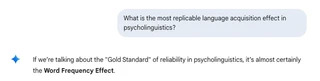
I once chatted with colleagues who study word acquisition, and we generally agreed that the most replicable phenomenon in language research is the Word Frequency Effect. Out of curiosity, I asked Google Gemini:
What is the most replicable language acquisition effect in psycholinguistics?
As expected, Gemini gave the same answer: the Word Frequency Effect.
The Scientific Perspective: What Is the Word Frequency Effect?
To the best of my knowledge, discussions of the word frequency effect date back to at least 1935 (see Preston 1935: The speed of word perception and its relation to reading ability).
Simply put, the word frequency effect means that the more often a word appears, the easier it is for the brain to recognise it. Eye-tracking studies in psycholinguistics show that readers spend significantly less fixation time on high-frequency words. For psycholinguists, the word frequency effect is one of the most robust findings in the language acquisition literature.
Isn’t the Word Frequency Effect Just “Practice Makes Perfect”?
Teachers, and even laypeople, might react to this idea by saying:
What’s so special about the Word Frequency Effect? Isn’t it just practice makes perfect?
……
Check out the full text on my Substack: Pacing Between Classroom and Lab

I am a researcher in psycholinguistics at the Ludwig-Maximilians-University of Munich, formerly trained and served as a Chinese language teacher in Hong Kong primary and secondary schools. My research revolves around the cognitive mechanisms underlying reading development and the methodology used to identify subtypes of developmental dyslexia. I also build infrastructures based on metascientific principles to help synthesise research findings in psychological sciences. I am committed to bridging the gap between scientific research and the actual practice in the educational and clinical settings. My goal is to translate cross-disciplinary knowledge for researchers, educators, practitioners, and parents by connecting insights across fields. I am currently leading the Re-SearchTerms Project at FORRT.
🌐 This website is bilingual (English / 繁體中文). Use the language switcher in the navigation bar to browse in your preferred language.