Re-SearchTerms: Terminology Variations in Metascience
Re-SearchTerms Is Growing
🚀 Now recruiting contributors worldwide!
Originally developed as part of my doctoral research at Ludwig-Maximilians-University of Munich, Re-SearchTerms is now expanding into an international, community-driven research project that I am leading in collaboration with FORRT!
We are building an open and evolving resource for examining how research concepts are defined, interpreted, and used across disciplines, languages, and research communities.
We are currently welcoming contributors interested in:
- collecting and curating research-term definitions
- expanding the resource across languages and disciplines
- annotating and validating existing definitions
- evaluating the app from an educational perspective
- testing and developing new app features
- supporting community development
- contributing to future presentations and publications
Contributors are welcome at all career stages, including undergraduate and postgraduate students, doctoral and postdoctoral researchers, academic researchers, educators, developers, and independent researchers!
No programming or advanced statistical experience is required for many of the available tasks.
➡️ Explore the Re-SearchTerms app
➡️ View the project repository
➡️ Email me about collaborating at leung.yi.lmu(at)gmail.com
What Is Re-SearchTerms?
Have you ever noticed that even when people use the same word or refer to the same concept, they may not have exactly the same meaning in mind?
In scientific research, we frequently use terms such as replication, open science, and transparency. We may assume that other researchers share our understanding of these terms. In reality, researchers from different fields, and even researchers within the same field, do not always define them in the same way.
Sometimes, these differences are merely a matter of wording. In other cases, they reflect fundamental differences in how scholars conceptualise a phenomenon. For readers of academic literature, this variation can lead to confusion and make it difficult to compare findings across studies.
I first became interested in this problem during my undergraduate studies in Chinese Language Education, when I encountered the concept of developmental dyslexia. Defining the central concepts of a thesis is a crucial part of the research process. At the time, the common approach was to identify the most “authoritative” definition, often by quoting an established dictionary or a publication from a prominent scholar or institution.
As I continued my studies, however, I realised how difficult it is to determine what truly counts as an authoritative definition. Definitions may differ across disciplines, theoretical traditions, geographical regions, and historical periods. They may also evolve as new evidence and perspectives emerge.
When I examined definitions of dyslexia more closely, I found that scholars from different regions and periods often emphasised different characteristics of the condition.
These differences are not necessarily a problem. Scientific research depends on the exchange and development of diverse ideas. Inconsistencies in the literature can encourage us to pause and reflect more carefully on what a concept means, how it is being operationalised, and whether researchers are genuinely studying the same phenomenon.
As part of my doctoral research, I therefore designed and developed Re-SearchTerms, an interactive Shiny app that enables users to examine how academic terms are defined and how their wording and usage vary across sources.
Why Does This Matter?
Scientific progress depends partly on researchers being able to understand one another.
When terminology varies across fields, researchers may:
- talk past one another
- use the same label to describe different phenomena
- use different labels to describe similar phenomena
- draw conclusions that appear contradictory
- operationalise the same construct in incompatible ways
- encounter difficulties when comparing or replicating findings
Using the same term for different concepts, or different terms for the same concept, is sometimes described as the jingle-jangle fallacy.
Terminological inconsistency can be particularly challenging in interdisciplinary research. However, variation in definitions may also indicate that an area of knowledge is still developing or that different theoretical perspectives are being explored.
Re-SearchTerms does not assume that every term must have one universally accepted definition. Instead, the project encourages researchers, students, and educators to pause and ask:
- What do we mean when we use a particular research term?
- Are there multiple ways to define the term?
- Why do these definitions differ?
- Do the differences reflect disciplinary, theoretical, historical, or linguistic contexts?
- Which definition is most appropriate for a particular research question?
- Is an existing definition sufficient, or should the researcher provide a new working definition?
- Which elements of a definition must be retained when it is paraphrased or operationalised?
The wording of definitions matters because scientific publications are records of knowledge. Researchers accumulate, communicate, and revise knowledge through language. Conceptual precision is therefore central to scientific communication.
This idea is reflected in the name Re-SearchTerms:
- “Re-” means to reconsider or think again.
- “Search” refers to searching for and comparing meanings.
- “Research terms” are the concepts through which scientific knowledge is communicated.
Re-SearchTerms therefore invites users to pause, think twice, and search again for the meanings of the terms used in research.
What Does the App Do?
Re-SearchTerms allows users to explore and compare definitions of research concepts collected from different sources.
Explore multiple definitions
Users can browse definitions collected from:
- academic articles
- research glossaries
- open-scholarship initiatives
- dictionaries and reference sources
Compare definitions across sources
Users can examine how definitions differ according to:
- academic discipline
- theoretical or research tradition
- publication source
- terminology context
Visualise conceptual relationships
Using natural language processing and network analysis, the app can:
- map word co-occurrence patterns
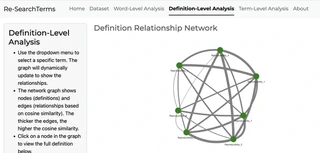
- display semantic-similarity networks
- show how definitions cluster together
- reveal relationships among research concepts
- identify terms with relatively similar or diverse definitions
These features transform abstract terminological differences into interactive and explorable representations.
How Does It Work?
In simplified terms, Re-SearchTerms uses computational text analysis to:
- divide definitions into meaningful linguistic units
- identify overlapping words and expressions
- estimate semantic similarity between definitions
- construct interactive network visualisations
- reveal patterns across concepts and sources
Users do not need technical knowledge to explore the app. The platform is designed to support reflection and critical engagement rather than overwhelm users with statistical information.
Researchers and educators who would like to adapt the app to their own disciplines, datasets, or teaching contexts can also access the source code and datasets.
➡️ Explore the code and data on GitHub
Who Is It For?
Students
Re-SearchTerms can help students:
- clarify terminology before writing essays, dissertations, or theses
- compare definitions from different academic sources
- understand how concepts vary across disciplines
- make more deliberate decisions when selecting definitions
Researchers
Researchers can use the platform to:
- compare definitions before preparing manuscripts
- identify conceptual inconsistencies in the literature
- examine whether studies use the same labels for different constructs
- reflect on the alignment between conceptual and operational definitions
- investigate how terminology develops across research fields
When researchers develop or select a measure, they must define the construct they intend to operationalise. Before deciding how a construct should be measured, they must first understand what the construct is intended to mean.
Educators
Educators may use Re-SearchTerms to:
- teach research methods and methodological literacy
- demonstrate how scientific language evolves
- introduce students to metascience
- support critical discussion of definitions and constructs
- encourage careful and transparent scientific writing
Interdisciplinary teams
Research teams can use the platform to:
- establish shared terminology at the beginning of a project
- identify differences in disciplinary language
- reduce misunderstandings among collaborators
- discuss conceptual assumptions before selecting methods or measures
A Metascience Tool
Re-SearchTerms contributes to metascience, the study of how science is conducted, communicated, evaluated, and improved.
By making terminological variation visible, the app may support:
- greater research transparency
- improved replicability
- clearer interdisciplinary communication
- more deliberate construct definition
- better alignment between concepts and measurements
- more reflective scientific writing
Re-SearchTerms complements the search for consensual or authoritative definitions by encouraging reflection and informed choice.
The purpose is not to prescribe one correct definition for every concept. Instead, the app helps users understand the available definitions, the contexts in which they are used, and the implications of selecting one definition rather than another.
Current Scope
The current dataset contains:
- more than 3,000 collected definitions
- more than 200 scientific concepts
- definitions from multiple academic and reference sources
- concepts related to metascience, open science, research methods, statistics, and reproducibility
The platform is designed to grow over time through additional sources, languages, annotations, and community contributions.
From Doctoral Research to a Community Project
The original version of Re-SearchTerms was developed as part of my doctoral research at Ludwig-Maximilians-University of Munich.
The project initially focused on collecting and analysing English-language definitions from metascience, psychology, open scholarship, and related methodological fields.
I am now leading the next phase of Re-SearchTerms, in which the project is being expanded from a doctoral research output into an international and collaborative research platform.
This next phase will involve:
- expanding the database across disciplines
- collecting definitions in multiple languages
- introducing community annotation and validation
- documenting contextual information about definitions
- evaluating the app as an educational resource
- developing new analytical and interactive features
- supporting community-led research questions
- producing future publications and open educational resources
The long-term vision is to build a living, multilingual, and community-curated infrastructure for conceptual transparency in science.
Join the Project
We are currently recruiting contributors worldwide.
There are several ways to become involved.
Definition collection and curation
Contributors may:
- identify definitions in academic publications
- extract and document relevant passages
- verify publication and source information
- help expand the database into new research areas
Annotation and validation
Contributors may:
- check whether an extracted passage genuinely defines a concept
- assess the contextual accuracy of definitions
- compare multiple definitions of the same term
- validate entries submitted by other contributors
Multilingual development
Multilingual contributors may:
- collect definitions in languages other than English
- examine how concepts are translated across languages
- identify terms without direct linguistic equivalents
- compare disciplinary and cultural differences in terminology
Pedagogical evaluation
Students and educators may:
- test the app in research-methods or open-science teaching
- evaluate its clarity and usability
- provide feedback on educational features
- help develop teaching activities and learning materials
Research and dissemination
Contributors may also:
- participate in future research outputs and publications
You do not need to be an established researcher or scientometrician to take part. Tasks vary in complexity, and many contributions do not require programming or advanced quantitative skills.
Interested in collaborating?
Please contact me with a brief introduction, including:
- your academic or professional background
- your research field or areas of interest
- the languages you work with
- the aspect of Re-SearchTerms that interests you
- how you might like to contribute
➡️ Email me about joining the project: at leung.yi.lmu(at)gmail.com
➡️ Explore the current app
➡️ Visit the GitHub repository
Looking Ahead
Future developments will focus on:
- expanding disciplinary coverage
- supporting multilingual terminology collections
- enabling collaborative annotation and validation
- developing teaching modules
- evaluating the app in educational settings
- improving data visualisation and navigation
- supporting new community-led research
- integrating human review with AI-assisted workflows
The long-term goal is not simply to maintain a static database. Re-SearchTerms is intended to become a living research infrastructure that grows as new terms, definitions, languages, annotations, and research questions are added.
Video Tutorials
View the full series of video tutorials
This introductory tutorial demonstrates the key features of Re-SearchTerms:
Try Re-SearchTerms
➡️ Launch the App
➡️ Explore the Code and Data on GitHub
➡️ Watch the Video Tutorials
Publication
The paper associated with the original Re-SearchTerms project has been accepted for publication in Meta-Psychology.
You can read the preprint here:
In a Nutshell
Re-SearchTerms helps us slow down, examine the words we use, and make more informed decisions about how research concepts are defined and communicated.
What began as part of my doctoral research is now developing into a broader international collaboration. I am currently leading this next phase of the project and welcome contributors interested in terminology, metascience, multilingual expansion, education, data annotation, or scientific communication.
If you are interested in contributing to Re-SearchTerms or adapting the platform to your own discipline, dataset, language, or educational context, please get in touch!
➡️ Email me about collaborating at leung.yi.lmu(at)gmail.com

I am a researcher in psycholinguistics at the Ludwig-Maximilians-University of Munich, formerly trained and served as a Chinese language teacher in Hong Kong primary and secondary schools. My research revolves around the cognitive mechanisms underlying reading development and the methodology used to identify subtypes of developmental dyslexia. I also build infrastructures based on metascientific principles to help synthesise research findings in psychological sciences. I am committed to bridging the gap between scientific research and the actual practice in the educational and clinical settings. My goal is to translate cross-disciplinary knowledge for researchers, educators, practitioners, and parents by connecting insights across fields. I am currently leading the Re-SearchTerms Project at FORRT.
🌐 This website is bilingual (English / 繁體中文). Use the language switcher in the navigation bar to browse in your preferred language.